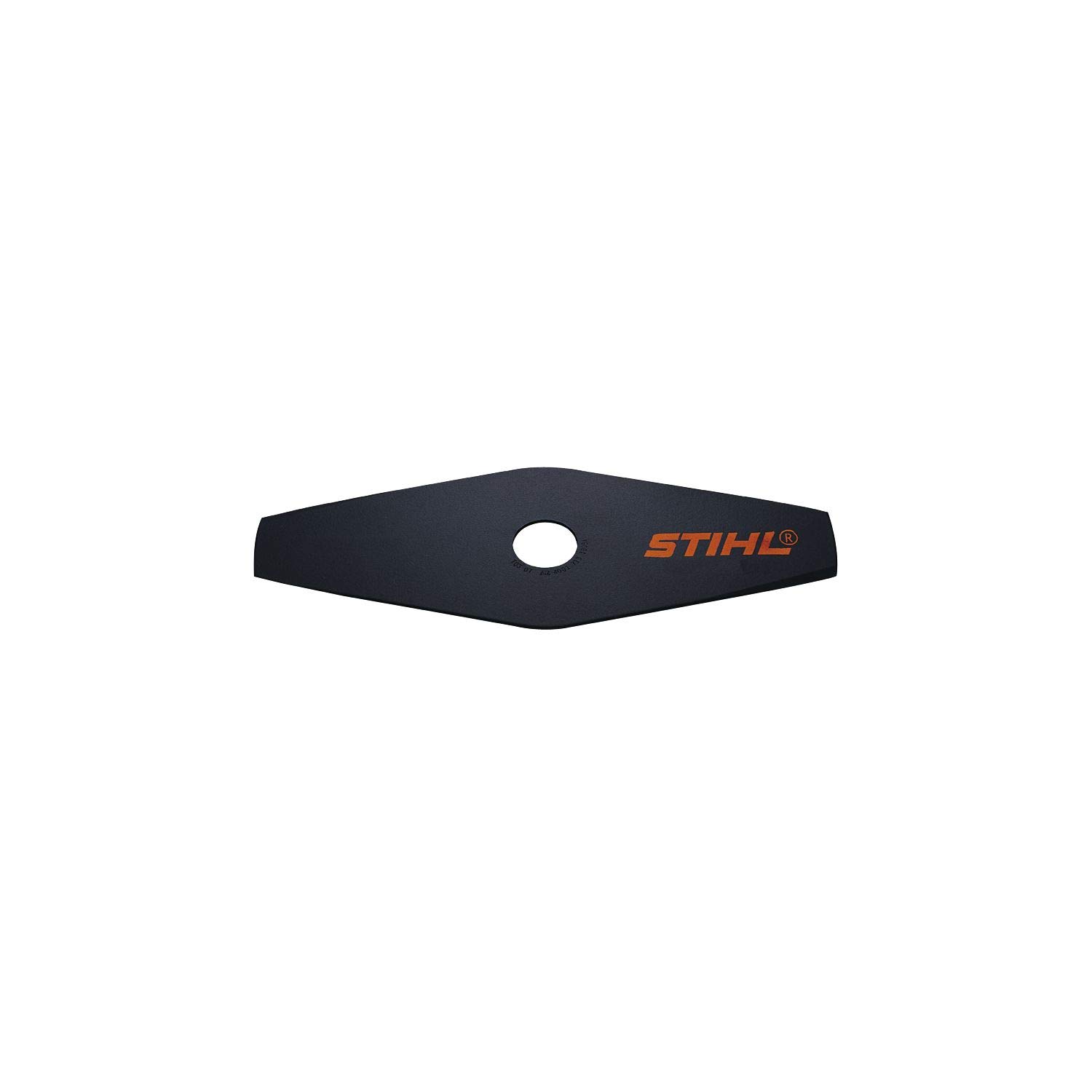
Stihl 2-Tooth Grass Blade 230mm
A steel 2-tooth grass blade for clearing dense grass and light weed growth, best suited to owners upgrading from nylon line on a Stihl brushcutter.
You'll be sent to Amazon in your country. Indicative price — live, localised pricing where available. As an Amazon Associate we earn from qualifying purchases.
Pros
- Cuts through matted or damp grass that shreds nylon line in seconds
- Lasts far longer than line, especially on gritty or overgrown ground
- Fits the standard blade mount used on most Stihl brushcutter gearheads
Cons
- Not designed for woody stems or saplings - that needs a 3- or 4-tooth or a dedicated saw blade
- Rigid steel, so it doesn't flick around obstacles the way line does
- Needs occasional sharpening to keep cutting cleanly
What it does
This is a 230mm steel grass blade with two cutting teeth, designed to replace a nylon trimmer head on a brushcutter. Where line works by whipping through soft grass, a metal blade shears through it, which makes a real difference once grass gets thick, tangled, or slightly damp - conditions that clog or snap line almost immediately. Two-tooth blades like this one are the classic choice for general grass and light weed clearance: they cut cleanly, spin with less drag than a line head, and don’t need constant re-spooling.
What to fit it to
Blades like this are made to match the standard blade adaptor found on most brushcutters with a straight or gearbox-driven shaft, rather than a simple trimmer head. The 25.4mm centre bore is a common fitment size, but you’ll still need to check it against your machine’s arbor and confirm the retaining nut, washer, and any adaptor plate you already have are compatible before ordering. If your machine only accepts a trimmer head and has no blade-capable gearbox, this blade cannot be fitted at all, and using metal blades on a machine not rated for them is a genuine safety risk. Most mid-size and larger Stihl brushcutters (as opposed to the smallest string-trimmer-only models) are built for this kind of blade.
Honest limitations
A 2-tooth blade is a grass and weed tool, not a brush-clearing one. It will struggle with woody stems, brambles, or anything thicker than a pencil - pushing it into that material risks kickback and dulls the edge quickly. For scrubby regrowth or small saplings, a 3- or 4-tooth blade or a toothed saw blade is the better choice. It’s also less forgiving around fence posts, stones, and tree trunks than a line head, since there’s no flexible line to absorb the impact - a chipped or bent blade should be replaced rather than used further. Expect to sharpen it every so often to maintain a clean cut, and always fit the correct guard and follow the manufacturer’s guidance on blade use before switching over from line.