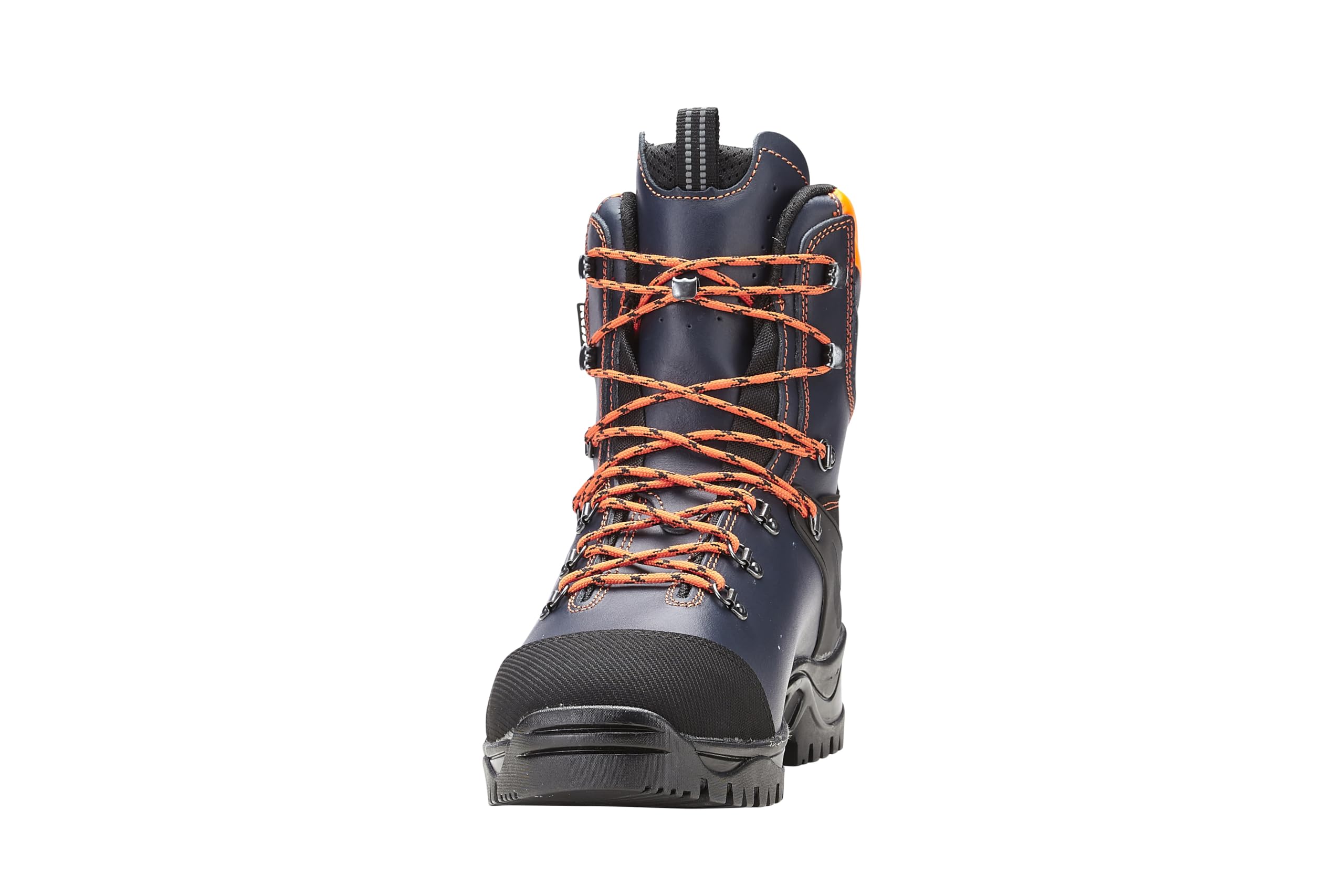
KOX Cut-Resistant Boots
Chainsaw-rated cut-resistant safety boots with steel toe and reinforced upper, for anyone running a brushcutter alongside a chainsaw or clearing saw.
You'll be sent to Amazon in your country. Indicative price — live, localised pricing where available. As an Amazon Associate we earn from qualifying purchases.
Pros
- Genuine chainsaw-tested cut resistance, not just a general safety-boot rating
- Steel toe and penetration-resistant sole add all-round protection on top
- Cleated sole gives solid grip on wet grass, mud and sloped ground
Cons
- Class 1 rating suits lower chain speeds, not top-spec professional saws
- Heavier and stiffer than a plain S3 work boot
- Cut-resistant layers add cost over standard steel-toe footwear
What they do
Most safety boots are built to stop impacts, punctures and wet feet, but they offer no real defence against a moving chain or blade. These are rated to EN ISO 17249, Class 1, the standard for footwear tested to resist a chainsaw running at 20 m/s — the same principle as chainsaw trousers, where an outer layer is cut through instantly but the reinforced fibres underneath jam the chain before it reaches the foot. On top of that they carry a steel toe cap and a penetration-resistant sole, so you get impact and puncture protection alongside the cut resistance, rather than having to choose one or the other.
For brushcutter work this matters even without a chainsaw in hand: a metal brush blade or a slipped strimmer head can behave much like a chain on contact, and the reinforced upper gives a genuine buffer that an ordinary steel-toe boot doesn’t. The cleated, oil-resistant sole is worth having too, since a slip on wet grass or a muddy bank is a far more common cause of injury than the blade itself.
Choosing and fitting
There’s no bore size or shaft to match here — these are a standard lace-up boot, sized like normal work footwear by EU shoe size. Because the steel cap and reinforced upper don’t flex or stretch the way plain leather does, it’s worth trying a half-size up if you’ll be wearing thick work socks, and checking width if you have a wider foot before committing to a size.
Class 1 covers most garden, smallholding and brushcutter-plus-occasional-chainsaw use. If you run a high-output professional saw regularly or work at higher chain speeds, look for a Class 2 or 3 rated boot instead, since Class 1 is tested only up to 20 m/s.
Honest limitations
Class 1 is a floor, not a ceiling: it protects against the chain speeds most brushcutters and entry-level saws produce, but it isn’t rated for faster professional equipment. The reinforced upper adds weight and stiffness compared with a plain S3 boot, so these are a better fit for regular chainsaw-adjacent work than for someone who only ever strims grass. As with any cut-resistant safety gear, the protective layers are a last line of defence, not a substitute for proper technique, and a boot that’s actually been cut into should be retired rather than trusted again.