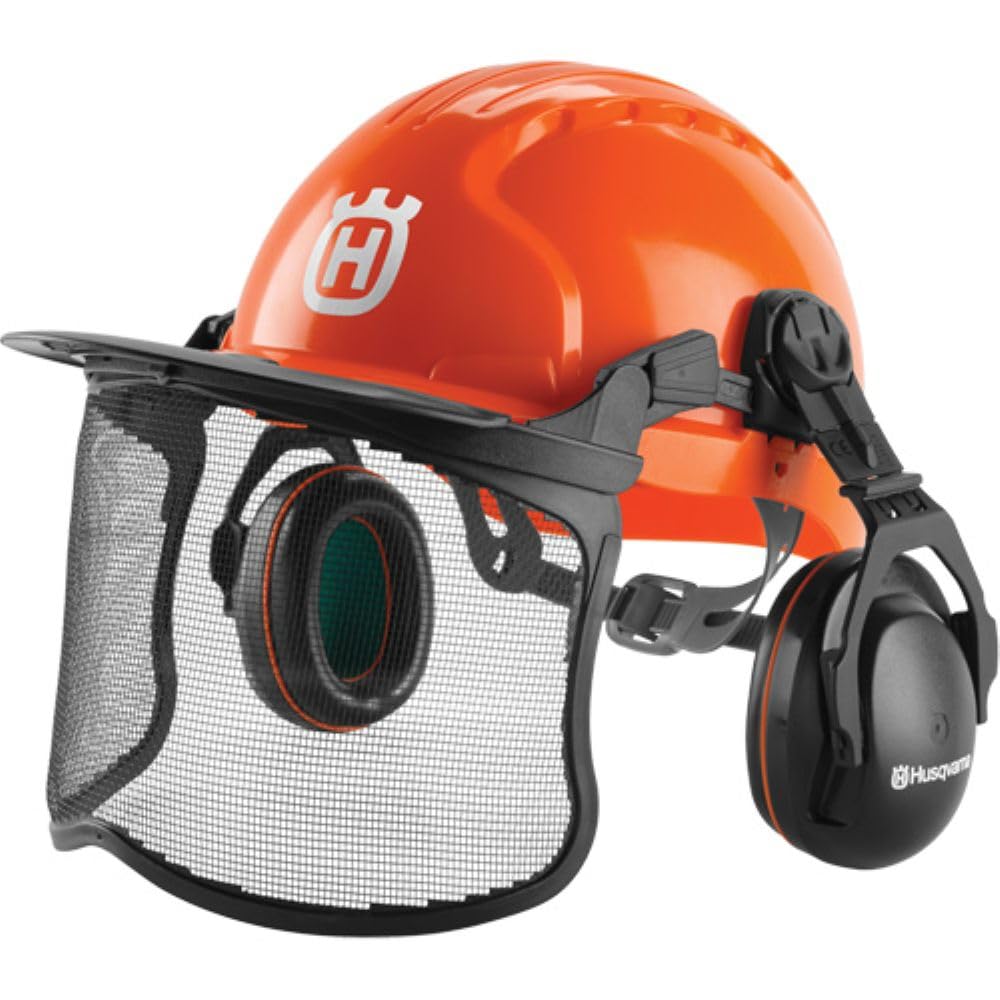
Husqvarna Technical Forestry Helmet
An EN-certified helmet, visor and ear defender combination built for brushcutter and chainsaw work, giving head, face and hearing protection in one fitted unit.
You'll be sent to Amazon in your country. Indicative price — live, localised pricing where available. As an Amazon Associate we earn from qualifying purchases.
Pros
- Three certified protections (impact, face, hearing) in a single fitted unit
- Ratchet adjustment makes it quick to size and share between users
- Vented shell keeps it wearable through long sessions
Cons
- Bulkier and heavier on the head than a helmet worn alone
- Mesh visor protects against debris, not against a blade strike to the face
- Ear defenders and visor arms add width, so it can catch on low branches
What it does
This helmet bundles the three pieces of protective gear most brushcutter work actually calls for: a hard hat rated to EN 397 for impact from falling branches or debris, a mesh visor rated to EN 1731 to stop flying stones, twigs and cut vegetation reaching the face, and integrated ear defenders offering SNR 27 dB of hearing protection under EN 352-1. Buying these separately usually costs more and leaves you juggling three straps and adjustments; here they’re pre-fitted to the shell, so putting it on is a single action rather than three.
The vented shell matters more than it sounds — a sealed helmet gets hot fast once you’re walking rough ground with a petrol machine running, and poor ventilation is one of the main reasons people stop wearing head protection after the first few uses. The ratchet headband and dial adjustment mean it can be resized in seconds, which is genuinely useful if more than one person on a smallholding or work team shares the same helmet.
Choosing and fitting
There’s no exact bolt pattern or fitment to check here — this is a standalone helmet system, not something that has to match a specific machine. The main fit points are head circumference (covered by the ratchet dial across most adult sizes) and personal tolerance for weight and bulk on the head. If you already wear glasses or safety goggles, check that the visor sits far enough forward to clear them without fogging or pressing on the frames.
The ear defenders are fixed to the helmet arms rather than a separate headband, so they fold up out of the way when not needed but can’t be swapped for a different attenuation level. If you regularly run a particularly loud machine for long stretches, that fixed SNR 27 dB may be lower than a dedicated high-attenuation headset offers.
Honest limitations
The mesh visor is designed to stop thrown debris and vegetation, not to protect against a direct blade or chain strike — it is not a substitute for keeping proper distance and technique around cutting attachments. The combined unit is also heavier and wider than a bare helmet, which some users notice on the neck during a full day’s work, and the extra width from the visor and ear defender arms can catch on low branches or dense brush more than a slimline helmet would. Like all safety headwear, the shell should be replaced after any significant impact, and the padding and straps checked periodically for wear rather than assumed to last indefinitely.