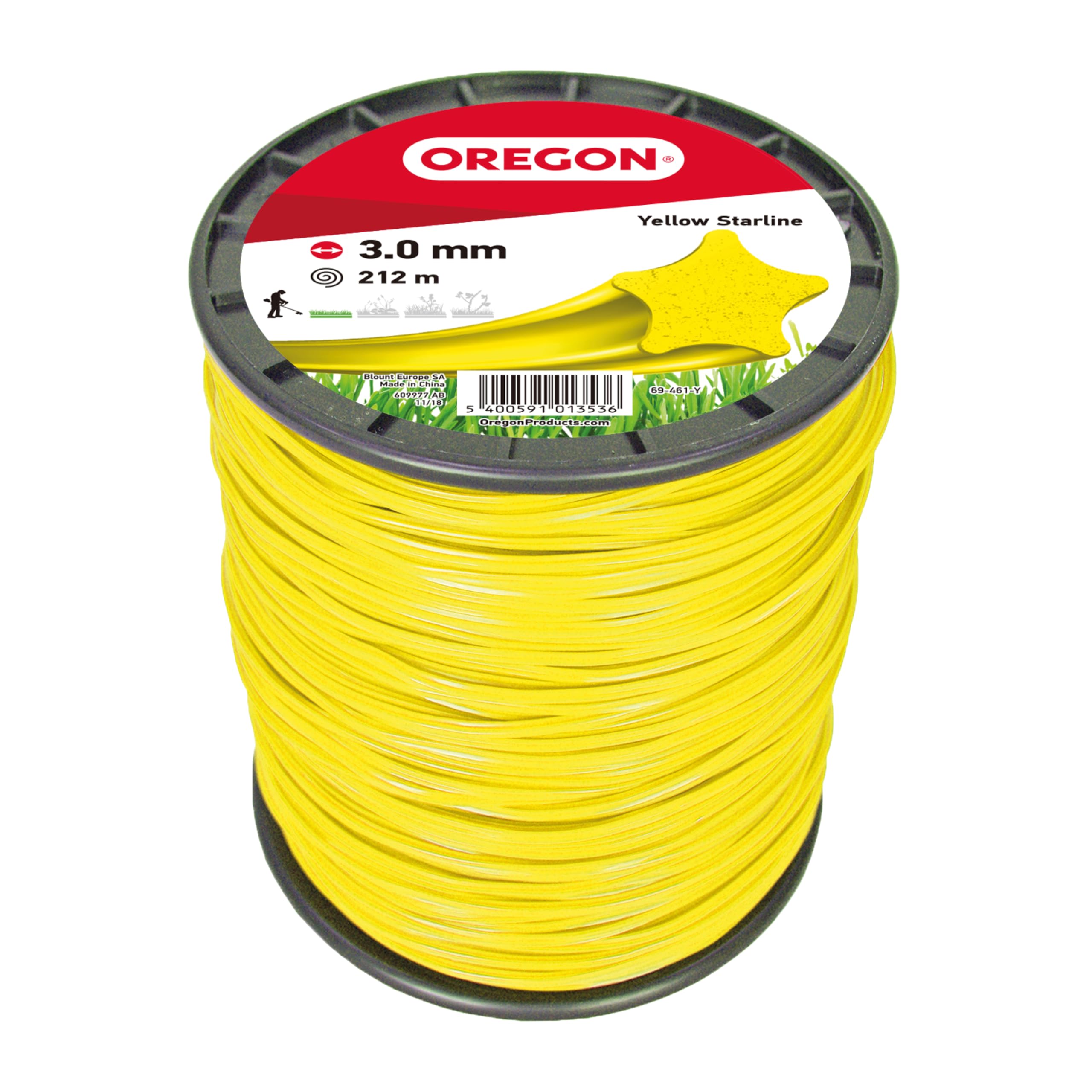
Oregon Starline 3.0mm
A thick 3.0mm twisted-profile nylon trimmer line built to cut more aggressively through tough weeds, suited to powerful petrol trimmers and brushcutters.
You'll be sent to Amazon in your country. Indicative price — live, localised pricing where available. As an Amazon Associate we earn from qualifying purchases.
Pros
- Twisted edges slice through tough weeds and light brush better than round line
- Thick 3.0mm gauge resists snapping under heavy, repeated use
- Well suited to high-power petrol trimmers and brushcutters
Cons
- Too thick and aggressive for small electric or cordless trimmers
- Runs noisier and vibrates more than round profile line
- Wears down faster against kerbs, fences and stone edging
What it is
Oregon Starline 3.0mm is a twisted, square-edged nylon trimmer line rather than the more common round profile. The twist gives the line four cutting edges instead of a smooth round surface, so as it spins each edge takes a small slicing bite out of whatever it hits. Combined with the thick 3.0mm gauge, that makes it noticeably more effective on tough, fibrous weeds, brambles and light woody growth than a standard round line of the same diameter would be. It’s aimed squarely at heavier-duty strimming jobs rather than routine lawn-edge tidying.
Choosing and fitting
Line this thick is only appropriate for machines with the head and motor to match. Check your trimmer’s manual or the marking on the bump head itself: most small electric and battery trimmers are built for 1.6-2.0mm line, while mid-size machines typically run 2.0-2.5mm, and it’s really the higher-power petrol trimmers and dedicated brushcutters (often running a 2-stroke engine and a solid shaft) that call for 2.7-3.0mm line. Fitting 3.0mm twisted line into a head designed for something thinner can overload the feed mechanism, strain the motor, or simply refuse to feed at all, so this is not a line to buy on the assumption that “thicker is always better.” Loading follows the usual pattern for the head type - wound onto a bump-feed spool in the marked direction, or cut to length for a fixed-line disc head - with the correct length left free at each end for good balance.
Honest limitations
The aggressive cutting action that makes twisted line good on tough weeds also means it runs louder and transmits more vibration through the shaft than round line, which some users find tiring over long sessions. It’s also a harder-wearing item to buy than it is to use gently: contact with stone edging, kerbs or fence posts will chew through the twisted edges faster than on smoother round profiles. And despite the improvement over round line on brush, this is still nylon trimmer line, not a blade - genuinely woody stems or dense scrub will still call for a 3-tooth or 4-tooth blade attachment rather than any thickness of line. For general lawn and border work, a standard round 2.0-2.4mm line remains the quieter, longer-lasting, and more appropriate choice.