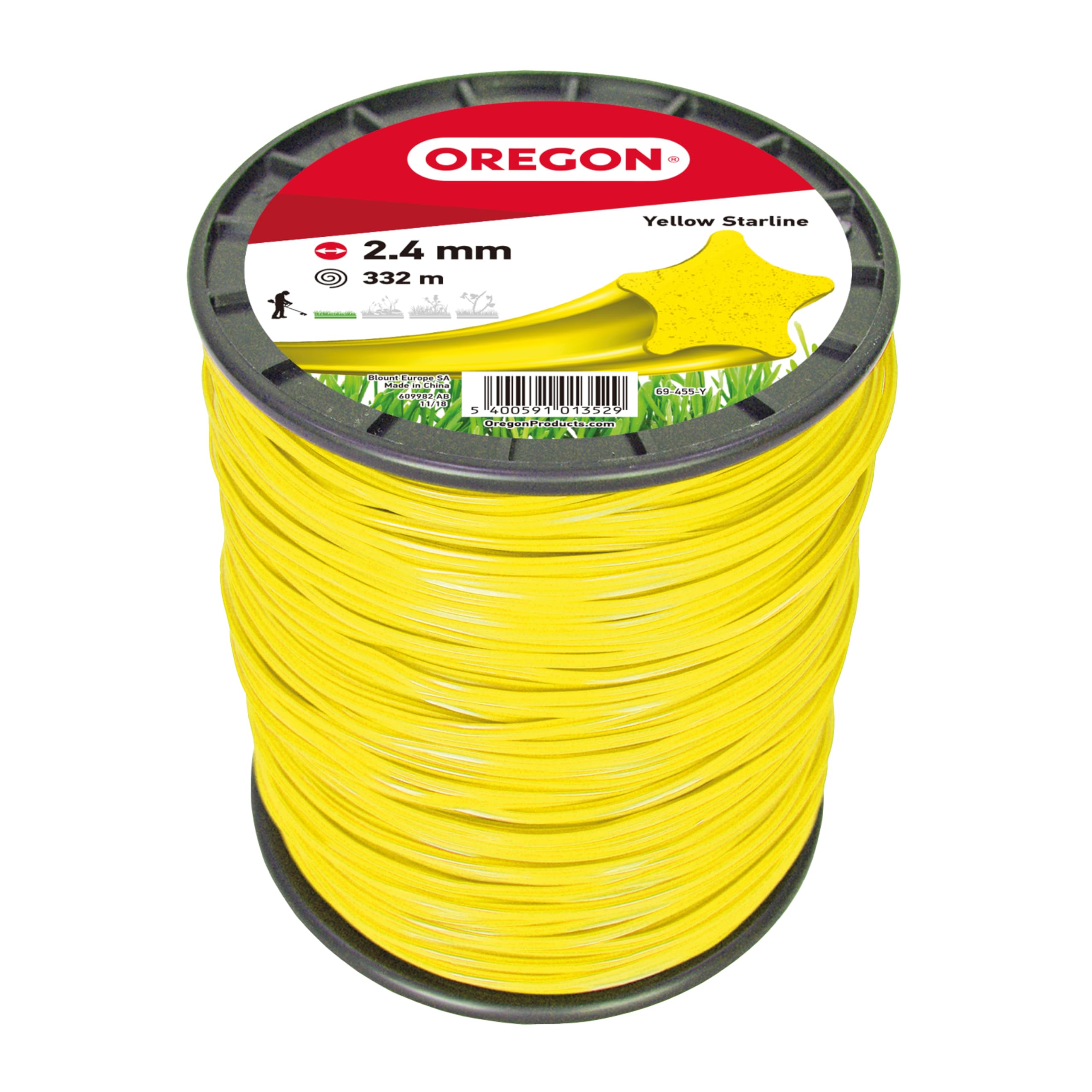
Oregon Starline 2.4mm
A round-profile 2.4mm nylon trimmer line built for durability, suited to medium-power trimmers cutting regular garden grass.
You'll be sent to Amazon in your country. Indicative price — live, localised pricing where available. As an Amazon Associate we earn from qualifying purchases.
Pros
- Thick enough to resist snapping on everyday grass and weeds
- Round profile runs quietly and feeds smoothly through most bump heads
- Reliable Oregon manufacturing quality
Cons
- Round profile cuts less aggressively than square or twisted line
- Too thick for small, low-power trimmers with narrow line channels
What it is
Oregon Starline 2.4mm is a round-profile nylon trimmer line, one of the most common diameters used on mid-size petrol and cordless trimmers. Round line like this is the general-purpose default: it feeds evenly, runs quietly, and holds up well to everyday contact with fences, stones and soil without shredding on the first few passes. At 2.4mm it sits toward the thicker end of the common range, which means more cutting mass hitting the grass and better resistance to breaking on tougher stems, brambles or overgrown patches.
Choosing and fitting
The main thing to check before buying is your trimmer’s head. Bump-feed and fixed-line heads are built for a specific diameter range, usually printed on the head itself or in the trimmer’s manual — most small electric trimmers take 1.6-2.0mm line, while mid-size petrol machines commonly run 2.4-3.0mm. Fitting line that’s too thick for the head can jam the feed mechanism or strain the motor; too thin and it wears out fast without doing much cutting work. If your trimmer’s manual quotes 2.4mm (or a 2.0-2.5mm range), this spool should be a straightforward match. Loading is the usual routine: wind it onto the spool in the direction marked, leaving the recommended length free at each end.
Honest limitations
This is a round line, so it won’t cut as aggressively as square-edged or twisted/serrated lines when tackling thick, woody weeds or dense brush — those profiles have sharper edges that slice rather than whip through material. For a typical lawn, garden borders and light weeds, though, the difference is minor and round line’s smoother, quieter running is arguably the better trade-off. It’s also not a substitute for a blade attachment: for anything genuinely woody or thick-stemmed, a 3-tooth blade will outperform any line, regardless of diameter. As with all trimmer line, expect faster wear against concrete, brick edging or stone than against grass alone.